
Commodity vs non-commodity content: why Google and AI skip most of what you publish
You have been posting to your blog. A “10 tips” article here, a “what to look for when hiring a [your service]” post there. Someone told you consistency matters, so you kept at it. And nothing much happened. No new customers who found you on Google. And lately, when you ask ChatGPT or Google’s AI to recommend a business like yours, it never says your name.
There is a reason for that, and in April Google said it out loud.
Jump ahead
- Commodity vs non-commodity content: why Google and AI skip most of what you publish
- What Google said in Toronto
- Commodity content is the version anyone could write
- What this looks like for a business like yours
- Why this matters more now that AI answers first
- Is this why your website isn’t getting found?
- The one question to ask before you publish
- How we write non-commodity content for SEO clients
- What to do this week
- The takeaway
- Get on our list for a new Findability Tip every Tuesday.
What Google said in Toronto
In April 2026, Google held its first Search Central Live event in Canada. Danny Sullivan, the person who speaks for Google Search, put up a slide that split all web content into two piles: commodity and non-commodity. Then he asked a room full of SEO professionals to look at their own sites and decide which side of the line they were on. Search Engine Roundtable covered the talk.
His description of the good kind came down to three words: unique, specific, and authentic. Content that brings a viewpoint others cannot easily copy, that talks about a specific real situation instead of general rules, and that shows first-hand knowledge. Everything else is commodity.
Commodity content is the version anyone could write
Commodity content is the generic take on a topic. Same structure, same talking points, same advice you can find on a hundred other pages. It is not wrong. It is just replaceable. The internet is not running low on “10 tips” posts, and it will cope without another one.
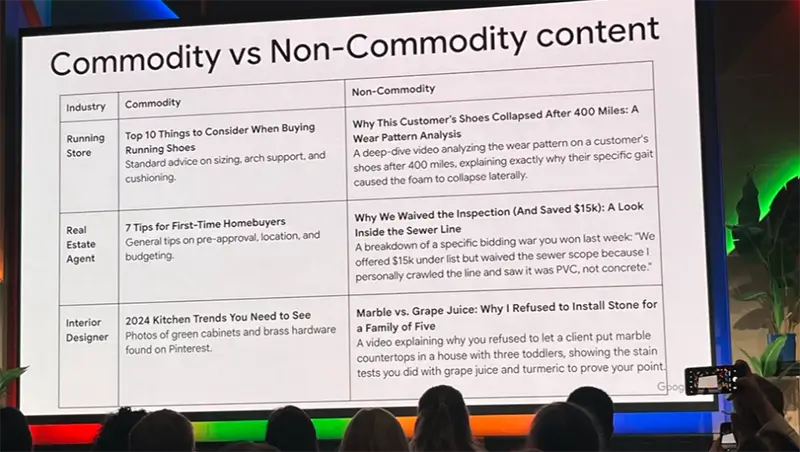
Google’s own slide used three examples to make the difference concrete.
A running store. The commodity post is “Top 10 things to consider when buying running shoes.” The non-commodity version is “Why this customer’s shoes collapsed after 400 miles: a wear-pattern analysis,” a breakdown of one real pair and exactly why that runner’s stride wore the foam down on one side.
A real estate agent. Commodity: “7 tips for first-time homebuyers.” Non-commodity: “Why we waived the inspection and saved $15,000: a look inside the sewer line,” the story of one specific deal and the judgment call behind it.
An interior designer. Commodity: “2024 kitchen trends you need to see.” Non-commodity: “Marble vs grape juice: why I refused to install stone for a family of five,” with the video of the actual stain test.
Notice the pattern. Every non-commodity example is one real case, a real number, and a point of view that could only come from the person who was there. None of it can be faked with a longer word count.
What this looks like for a business like yours
Most business owners we work with have a blog full of commodity content and do not know it. It reads fine. It is also invisible.
Say you run a plumbing company. “Signs you have a slab leak” is commodity. Every plumber has that post. “How we found a slab leak under a 1960s Riverside home by listening through the foundation, and what the repair actually cost” is non-commodity. Only you have that job, that house, that number.
Say you are a coach. “Five ways to beat procrastination” is commodity. “The real reason my client kept missing her launch date, and the one change that fixed it” is non-commodity. The difference is not effort or length. It is whether the piece could exist without you.
Why this matters more now that AI answers first
Here is the part that raised the stakes. When someone searches now, an AI answer often sits on top of the results: Google’s AI Overviews, ChatGPT, Perplexity. These systems are very good at one thing in particular, summarizing commodity content. If your page says the same thing as a hundred others, the AI absorbs it, answers the question itself, and the reader never clicks through to you. Your best generic post becomes free training material.
Non-commodity content behaves differently. When a page has the one number, the one story, or the one named expert that nobody else has, the AI cannot summarize it away. It has to point at you. Getting cited is the new getting found.
That is the whole idea behind Findability OS, the method our SEO team uses to get clients showing up in both Google and AI answers. Findability OS is not a bag of tricks. It is the durable work of publishing content only you could publish, marked up so machines read it correctly, and backed by a real Google Business Profile and real reviews. The content half of it is exactly this: write the things a competitor could not copy.
Is this why your website isn’t getting found?
If you have published steadily and still do not show up, commodity content is the usual reason. Search engines and AI systems already hold ten versions of the generic post, so they have no reason to rank or quote yours. The page is fine. It is just one more copy of something the internet already had.
Getting found again starts with publishing the parts of your business that exist nowhere else: your real jobs, your real numbers, your real opinions.
The one question to ask before you publish
The test Could someone write this without your experience, your data, or your point of view? If yes, it is commodity. Rewrite it, or do not publish it.
That is the whole standard, and it is the same test Google’s team described from the stage. Google’s written guidance phrases it a little differently, asking whether a page offers “original information, reporting, research, or analysis” or “mainly summarizes what others have to say without adding much value.” Same line, drawn twice.
How we write non-commodity content for SEO clients
Our job as an SEO partner is not to hand you another content calendar full of commodity posts. It is to pull the non-commodity material out of your business, the material you are too close to notice.
In practice that means we interview you for the specific jobs, the odd cases, the numbers you actually track, and the thing a customer misunderstood last week. We look at what already ranks and what the AI already answers, then only publish where we can add something they do not have. We mark it up so search engines and AI tools read it cleanly, and we put it under a real byline so both Google and a human can tell who stands behind it.
It works. Ruben Ochoa, Global Marketing Director, told us: “Within 4 months of Website HQ taking over our SEO we generated more sales than we did in 5 years with our previous SEO company.” That did not come from generic posts. It came from content only his company could have produced.
What to do this week
You do not need to burn your blog down. You need to sort it.
Open your five most recent posts and run the test on each one. Could a competitor have published it word for word? Be honest. If the answer is yes, that post is commodity.
Then pick your single best service or result and write the specific version. Not “benefits of [your service],” but the real story of one customer, one number, one before-and-after. One post like that outperforms ten generic ones.
Add the details only you have: the actual price range, the real timeline, the photo you took yourself, the mistake you watch customers make. Vague copy does not get quoted. Specific copy does.
Last, check whether an AI tool already answers the questions your customers ask. If it does, and your page only repeats that answer, you have found a commodity page worth rewriting.
The takeaway
Commodity content is not a style problem. It is the reason a website can publish for a year and stay invisible in both Google and AI. The fix is not more content. It is content only you could write.
That is harder than a “10 tips” post, and it is the only kind that gets found now. If it sounds like more than you want to run on top of everything else, that is exactly the work we take off your plate, so you can run your business, not your website.