

AI website builders are good at one thing. They'll give you a decent-looking site in an afternoon for very little money. If you're starting from nothing, I'm not going to talk you out of one.
Andrew Cleveland wasn't starting from nothing. His company, Pacific Pond and Aquarium, builds and looks after koi ponds, waterfalls and fountains across Los Angeles and the San Fernando Valley, for homes and for commercial clients. His website came out of an AI builder. It looked fine, and it was bringing in work.
Underneath, it was slow, he couldn't change it without worrying he'd break something, and he couldn't tell which of his ads made the phone ring.
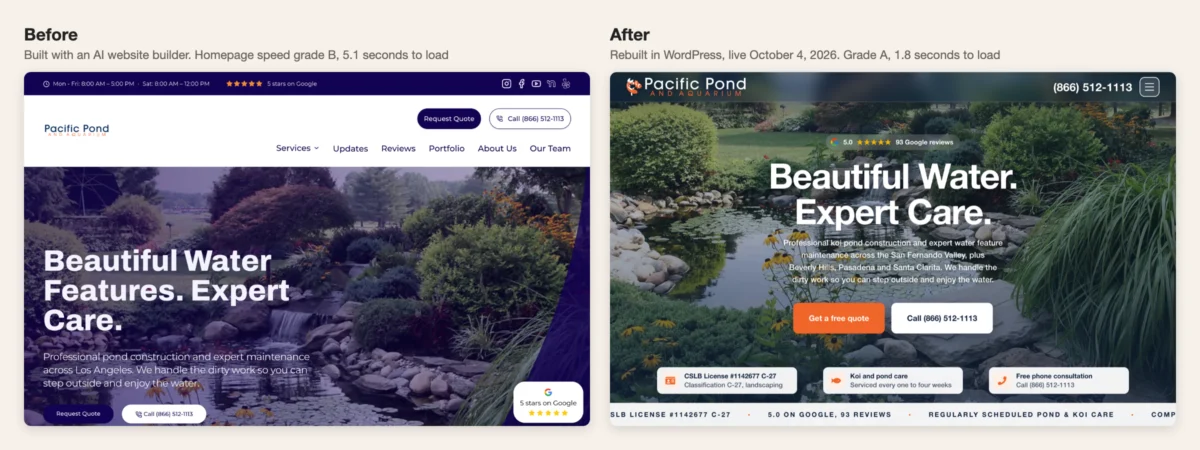
This fall my team moved it to WordPress. It went live the evening of October 4, 17 days after he signed. Every page we tested now gets an A for speed. And the move didn't cost him his rankings. Most of them went up.
Here's what we did, what Google did in the first 23 days, and the parts that haven't moved yet.
What was wrong with the AI-built site
Nothing you'd notice in a screenshot. That's the trouble with these sites.
The first problem was tracking, and it's the reason he called. "I have been unable to get either Facebook Pixels or Google Tracking to fully work," he told me on our first call. He had a landing page built just for his Facebook ads, with its own quote form, and the pixel never fired when someone sent it. So Facebook never learned who his customers were. His Google Analytics was still counting three events set up in 2023, and none of them worked on the site he had. When he put money into ads, he had no way to see what came back.
The second was control. He'd edited the service pages and the FAQs himself, but he was nervous about going further. "They write all this custom code," he said. "And then it's not easy to edit. I don't want to touch anything." On top of that, the company behind his builder had been sold, and he'd been told its websites were being wound down.
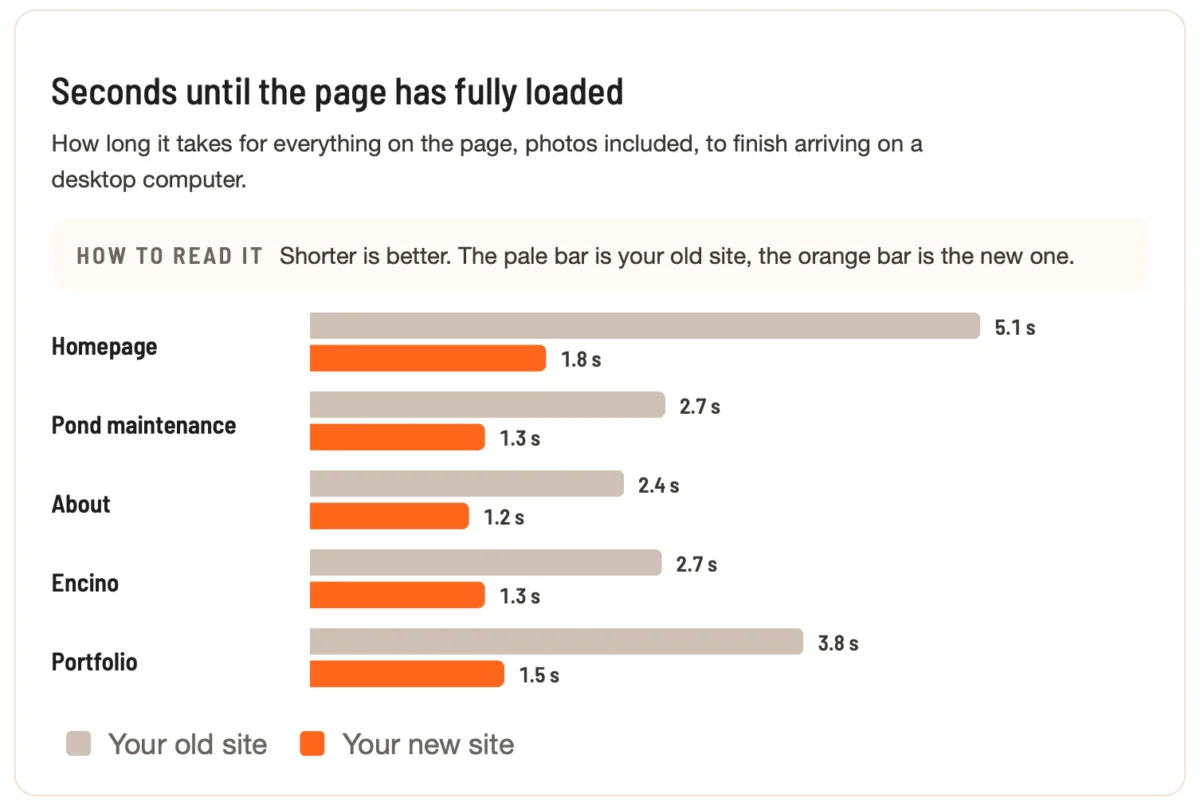
The third was speed. The day before launch, we ran five pages of the old site through GTmetrix: the homepage, pond maintenance, about, Encino and portfolio. One of the five got an A. The homepage took 5.1 seconds to finish loading. The pond maintenance page asked a visitor to download 12.8 MB, and the portfolio 14.4 MB, mostly full-size photos. Two pages jumped around while they loaded, at 0.72 and 0.70 on Google's layout shift score. Google calls anything over 0.25 poor.
That hurt most on phones. In the four weeks before launch, 215 of his 505 visits came from phones, and only 27 percent of those stayed past a quick look. On computers it was 48 percent.
One more thing turned up in testing. His old host answered automated visitors, the kind search tools and AI assistants send, with a "too many requests" error instead of the page.
What we did, and what we didn't
We didn't redesign it. His site was already bringing in jobs, and the thing he feared most about moving was losing what worked. So the look stayed close to what he had, with a cleaner top of the page and the quote button and phone number where a homeowner would look for them.
We started by listing every page on the old site before we touched anything. That came to 91 addresses: 55 pages and 36 project write-ups. Every one of them kept its exact address on the new site, including the pages with no link in the menu and his rate card. Pages that don't appear in a menu can still bring in search traffic, and they're the ones a rebuild loses most often.
A few older addresses were still in his ads and still in Google. Each of those now forwards to the matching page with a 301 redirect, so nobody lands on a dead page.
Every page got its own title, its own description and a photo that shows when someone shares the link. We sent Google the full list of pages the day after launch.
Tracking was the reason he hired us, so it had to work. A tap on his phone number now reaches Google Analytics, Google Ads and Facebook, and so does a sent quote request. Phone taps were counted from launch day, and quote requests from October 18. His quote form is still Jobber's form, so every request lands in Jobber the way it always did. We sent a test request on October 22, and it came through.
For speed, every photo is saved at the size it's shown, in a newer, lighter format, so a phone never downloads a photo meant for a big screen. The quote form loads when someone scrolls near it, so the top of the page isn't waiting on it. The site runs on WP Engine with Cloudflare in front.
We also ran an automated accessibility test against WCAG 2.2 at level AA, the standard most website accessibility claims are measured against. It found 13 problems on five pages of the old site. On all 110 pages of the new one it found none, and no text on the site is smaller than 16 pixels.
Every page we tested got an A
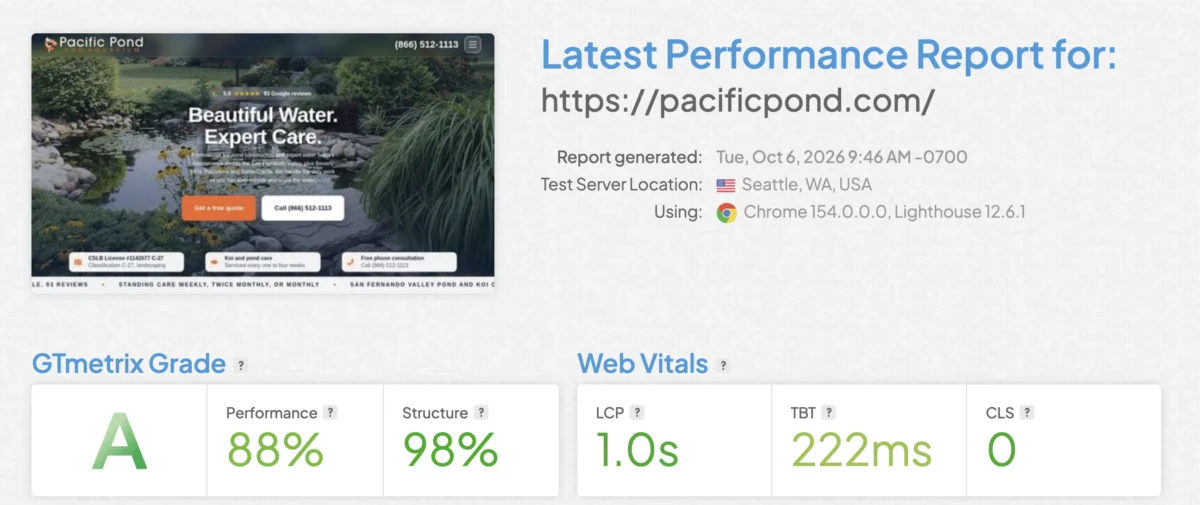
Same five pages, same test, same location, same browser. The old site was tested October 3 and the new one October 5, the day after launch.
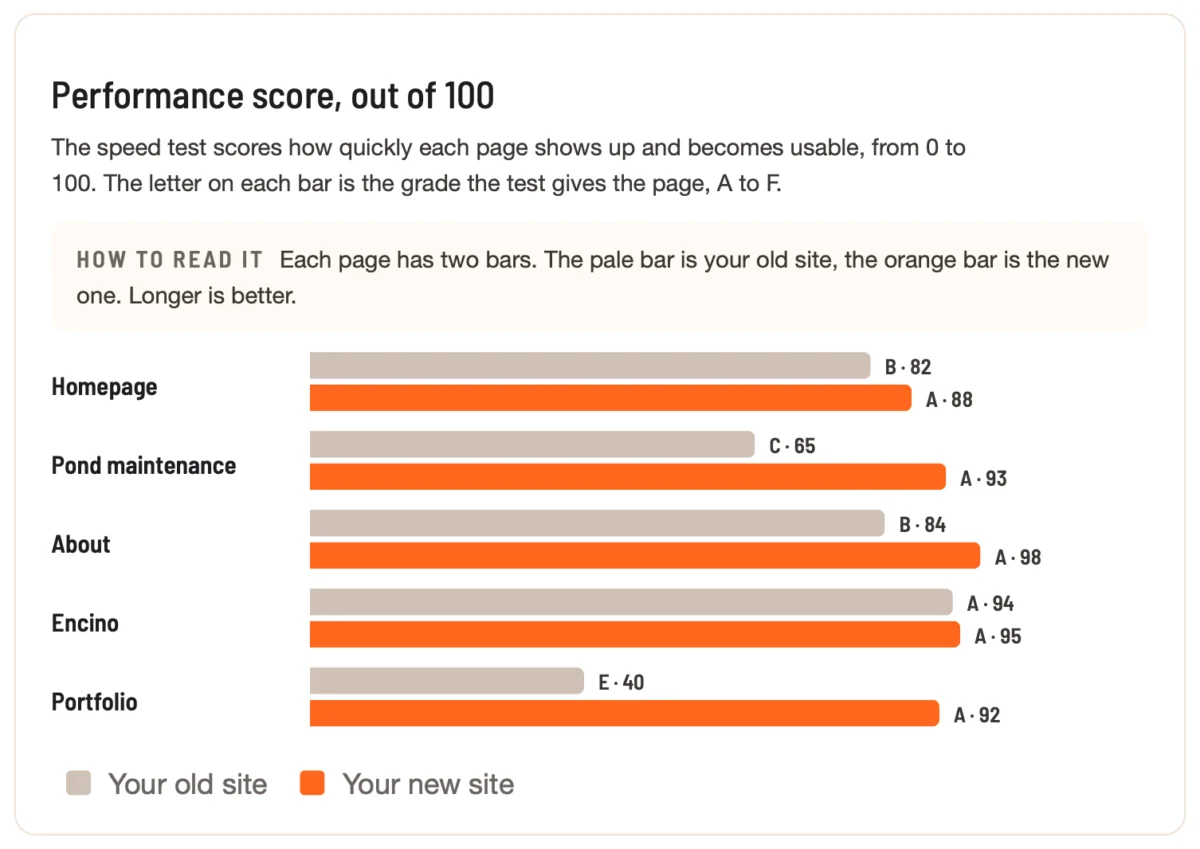
One page out of five earned an A on the old site. All five do on the new one. On average a page finishes loading in 1.4 seconds, down from 3.3, and the five pages together went from 33.3 MB to 7.5 MB.
Andrew read the report and wrote back that the site seemed much faster. Later that evening, in the middle of a note about his ads: "Did I say how pleased I am with progress on the site so far? I am."
What Google did in the first 23 days
Rebuilding a site is where rankings usually get lost, so this is the part I watch hardest. Scott Sumner on our team sends Andrew a report every 28 days. The first full one compares the 23 days after launch with the 23 days before it, using Google's own numbers from Search Console.
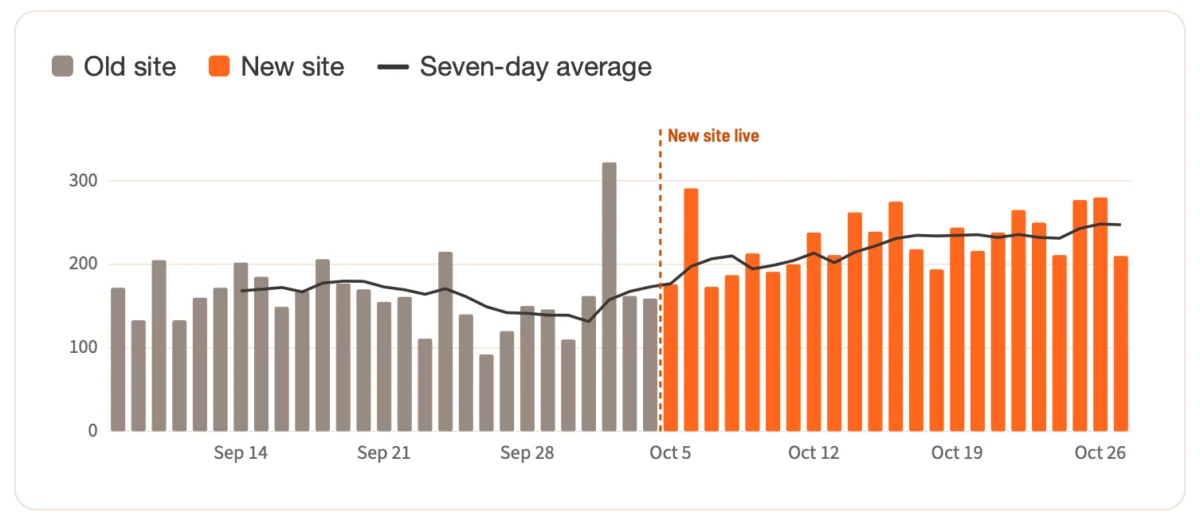
Google showed his site 5,259 times in the 23 days after launch, against 3,768 in the 23 days before. That's up 40 percent.
His average place in Google went from 17.8 to 12.4. Lower is better, and page one ends at 10.
Leaving out searches for his own name, the number of searches that put him on page one went from 137 to 255. The number that put him in the top three went from 37 to 87.
So did the move lose rankings? A few searches slipped, and I'll show you those. Of the 217 searches Google showed him for both before and after, 140 moved up and 48 moved down. Weighted by how often each one showed, they moved up 5.6 places on average. The biggest slip was an aquarium search, which is work he's steering away from and asked us not to chase. Three of the six biggest slips were less than two places.
Some of the climbs were big. "koi pond los angeles" went from place 50 to place 13. "pond builders near me" went from 27.7 to 4.3.
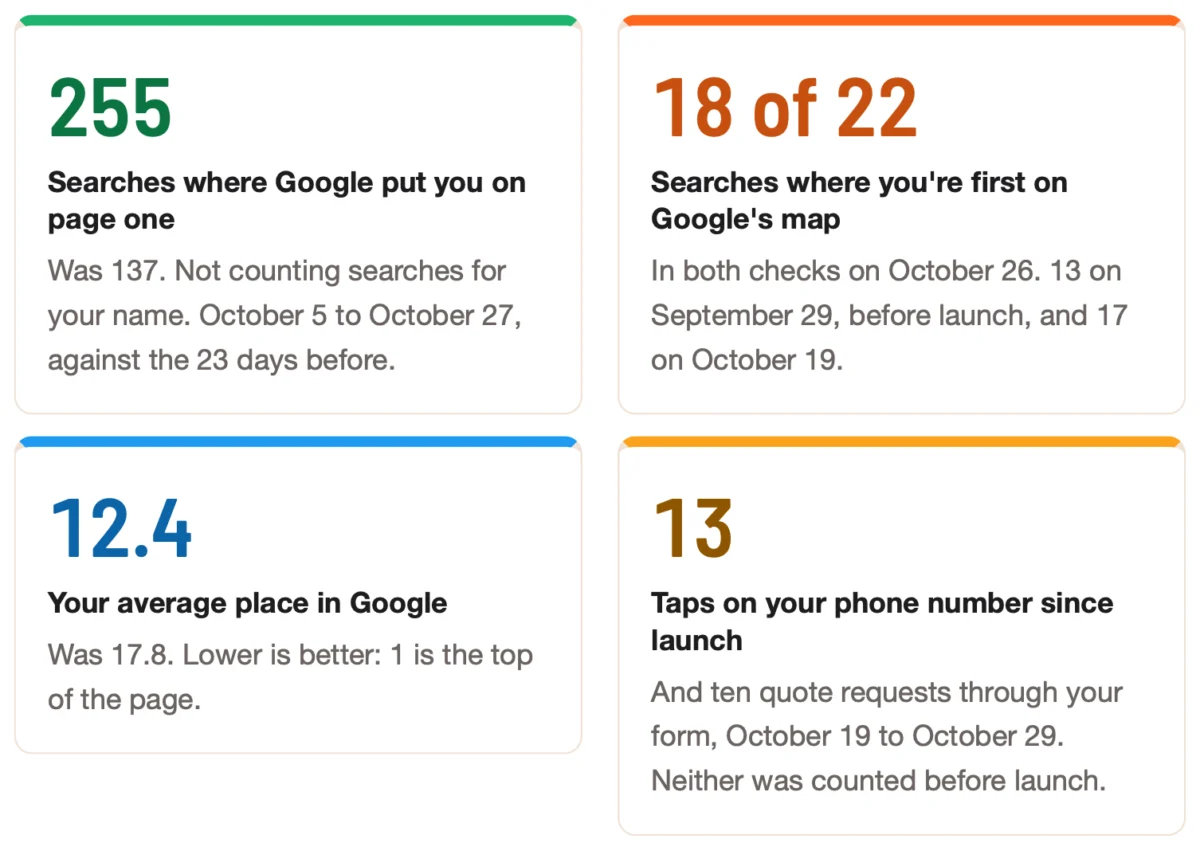
The map did even better. That's the box of three businesses near the top of a local search, and it's where most calls from Google start. Google showed his map listing 1,963 times since launch, more than twice the 821 before. Of the 22 searches his plan tracks, from towns across the Valley, he's first on the map for 18. Before launch it was 13.
People stay now
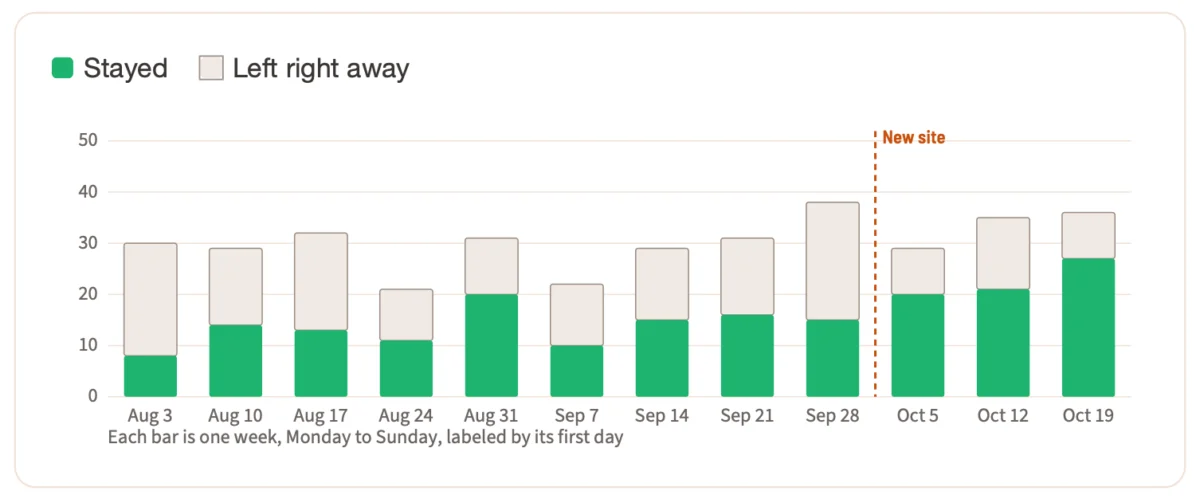
Google Analytics counts a visit as one that stayed when the person looks at a second page, stays ten seconds or more, or taps something. Before launch, 46 percent of the people who came from Google stayed. Since, 69 percent. On phones, the share of all visitors who stayed went from 31 percent to 44.
Leads are counted for the first time
Since launch, his site counted 13 taps on his phone number. Since we turned on quote request tracking on October 18, it counted ten quote requests, nine of them from the new quote page that every "Get a free quote" button leads to.
Here's what I can't tell you yet: whether he's getting more leads than before. Before, nothing was counting them. That was the whole reason he called. From here on, every month has a real number to compare against, and when he spends on ads, he'll see which ones pay.
What hasn't moved yet
Clicks from Google are about the same: 67 in the 23 days since launch, 64 in the 23 days before. Google is showing him more often and higher, but most of those showings land in places 4 through 20, and most clicks go to the top three. This is the usual order after a rebuild. Showings and position move first, and clicks follow once a page reaches the top three for the searches people actually use.
Forty of his 100 pages weren't in Google's index yet at the end of October, most of them project write-ups, plus his main design and construction page. Google visits a rebuilt site a little more each week, and we're asking it to read the main pages one at a time.
And fountains are their own field. Searches for fountain cleaning and repair put fountain specialists in the map box, and Andrew wasn't in it once. That's on purpose for now: fountains come last in his plan.
What comes next
The move was the first half of the job. The second half is SEO. His plan runs for twelve months, one group of pages at a time: ponds and koi first, starting in November, then pond construction, then commercial work, then fountains and water features.
His first city pages get rebuilt around a real job in each town. He's already first on the map in six of those seven towns, and the pages are how he wins the results under the map too. The goal is to be ranked and ready by mid-March, when the time changes and Los Angeles heads back into its backyards.
His site is looked after on our Site Care Club, so the updates, backups and security are ours to handle and he doesn't have to touch anything.
If your site came out of an AI builder
An AI builder can be a perfectly good first website. The risk shows up later, when your site already has rankings and somebody rebuilds it without a plan. Here's what protected Andrew's:
- Get a list of every page before anyone rebuilds anything, including the ones with no menu link.
- Keep every address, or point the old one at its new home with a 301 redirect.
- Bring the titles and descriptions Google shows in search with you.
- Make tracking part of "done." A test lead should land in your inbox or CRM and in your ad accounts before launch is called finished.
Then give it time. Judge a rebuild at two or three months, not two weeks.
If your site came out of an AI builder and you're wondering what a move would cost you in Google, book a call with me. We'll look at your pages together before anyone touches a thing.